
What is traditional Thai Massage? A complete guide for anyone who's never tried it
Origins, technique, benefits, and the three levels of the work (physical, energetic, spiritual). Written by someone who learned it at the source.
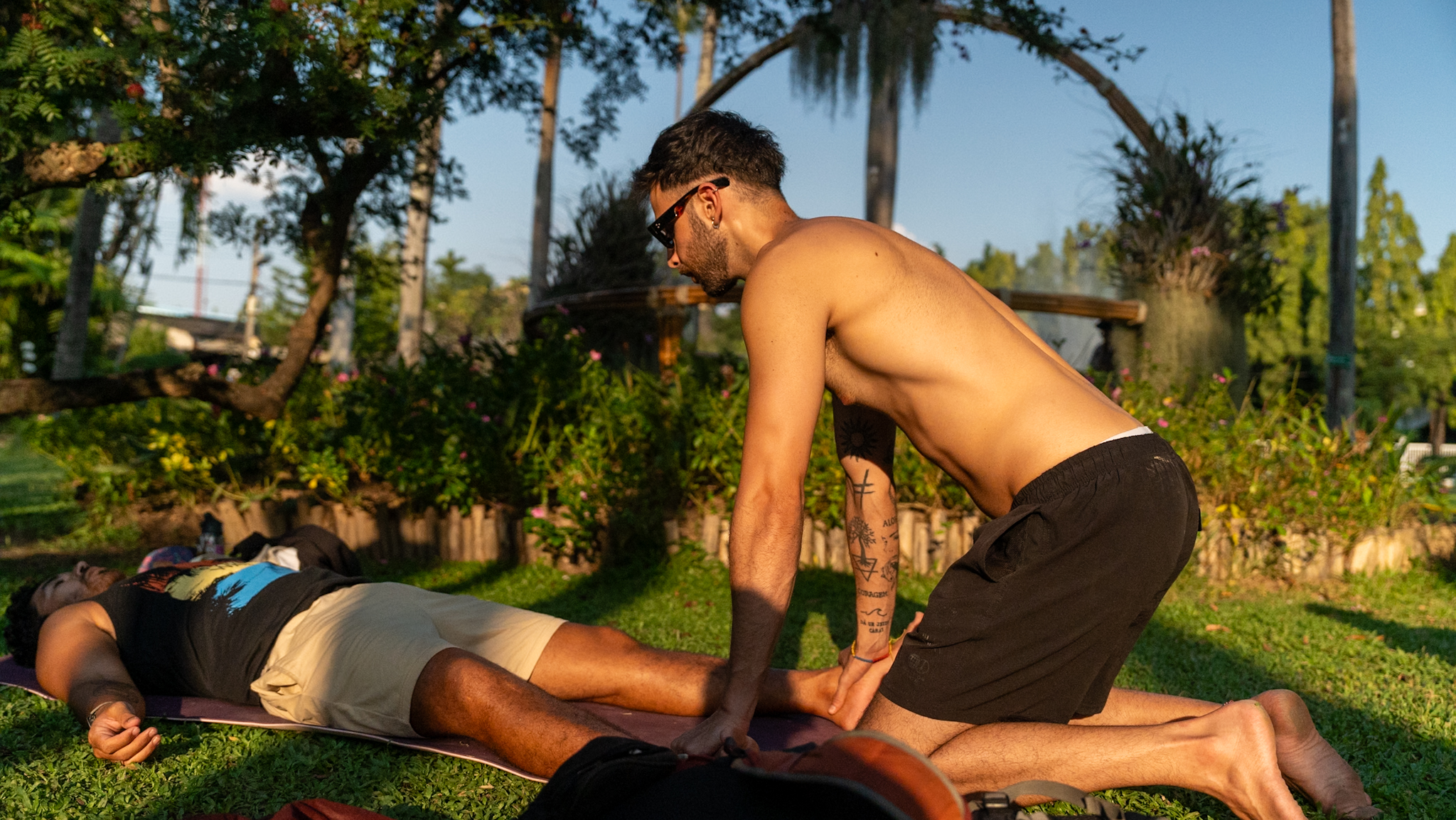
The first thing most people ask me is: “Is this like a regular massage, just stronger?”
It’s not. It’s not stronger. It’s not weaker. It’s something else.
Thai Massage, originally called Nuad Boran (literally “ancient work”), is a therapeutic practice over 2,500 years old. It was born in the temples of Thailand, passed down generation by generation between monks and healers, and even today it carries that root: it’s not spa technique, it’s bodywork with a history.
This guide is for anyone who’s never tried it and wants to understand what they’re about to experience, or for anyone who’s heard of it but isn’t sure yet if it makes sense for them.
The origin nobody tells you
The official history attributes the creation of Thai Massage to Jivaka Kumar Bhaccha, the physician contemporary to the Buddha, around 2,500 years ago. He was the personal doctor to the Buddha and to the Sangha (the Buddhist monastic community). His teachings spread along with Buddhism, from India into southeast Asia, and found fertile ground in Thailand.
But the practice that survived to today didn’t come only from India. It absorbed influences from Chinese medicine (with its energy lines and pressure points), from Ayurvedic medicine (with its idea of balancing the body’s elements), and from Thai folk wisdom itself.
For centuries, it was taught orally. Father to son, master to disciple. Only recently, in the last few decades, has it been systematized into formal schools.
When I went to Thailand to study, I trained at the source of the tradition. From there I went to India to immerse myself in yoga, which deepened my energetic understanding of the work. And what marked me most in both formations wasn’t the technique itself. It was the posture behind it.
In those traditions, massage isn’t a service. It’s an offering. It’s an act of care with a spiritual dimension.
The three levels: physical, energetic, spiritual
This is what most distinguishes Thai Massage from everything else. It was born integrated, not fragmented. When practiced well, it works the body on three simultaneous dimensions:
Physical: deep muscular release, fascia softening, joint mobilization, spinal decompression. The part you can see and measure.
Energetic: direct work on the body’s energy centers (chakras) and the energy lines (sen). The body rests from what it had been holding.
Spiritual: The touch comes from presence and intention, creating a meditative field. The massage is done with the heart before the hands. It is not empty technique. It is integrative practice.
When someone leaves a session saying “I can’t explain it, but something shifted,” they’re describing the three levels working together. That’s what separates a deep session from a regular massage.
How it actually works
Forget what you’ve seen in a spa. Traditional Thai Massage has three characteristics that set it apart from everything else:
1. It’s done on the floor, on a futon
Not a table, not a massage bed. It’s a traditional mat on the floor, which gives the therapist room to use the entire body (feet, knees, legs, hands, elbows) and lets you receive in different positions.
2. It’s done with clothes on
No oil, no undressing. You stay in comfortable clothes (pants and a t-shirt, ideally). This completely changes the sensation: there’s no “feeling exposed,” and the work can go much deeper without skin-on-skin oil friction.
3. It combines pressure and stretching
The session has two main movements that alternate:
- Conscious pressure along the energy lines (sen): according to the Thai tradition, the body is crossed by 72,000 energy lines. Ten of them are the main ones. The therapist works along these lines with calibrated pressure, releasing blockages.
- Passive stretches (yoga-like): you’re placed in postures that mobilize joints, open the hips, lengthen the spine. But you don’t make any effort. I do it for you.
This is why many call it “assisted yoga.” It’s a partial description, but it captures something real: the end result feels like a deep yoga practice without having done the work to get there.
What changes in the body
The physical effects of Thai Massage are well documented:
- Improved circulation (blood and lymphatic)
- Release of deep muscular tension, especially in shoulders, neck, hips, and lower back
- Increased joint mobility (especially in hips and spine)
- Reduction in chronic pain, mainly in the lumbar and cervical regions
- Better sleep quality (many people report sleeping unusually deep the following night)
- Regulation of the autonomic nervous system (moves out of “fight or flight” mode into “rest and regeneration”)
But what I see in practice, session after session, goes beyond the physical. People leave more connected to their own bodies. Some cry during the session without knowing why. Others sleep ten hours the following night. Others can only say they feel “different” without being able to explain.
That’s real bodywork. It touches what’s been held.
Who benefits most
Thai Massage is versatile, but some profiles tend to have particularly noticeable results:
- Desk workers (programmers, writers, managers) who accumulate tension in shoulders, neck, and hips
- Athletes (runners, surfers, lifters) who need deep muscular recovery
- People dealing with chronic anxiety or stress looking for something deeper than talk therapy alone
- People who never stop and need a space where the body can really slow down
- Anyone seeking integrated bodywork, not just physical relief
- Digital nomads and travelers living out of a backpack whose bodies hold the cumulative cost
It’s not indicated (or needs to be discussed first) for:
- High-risk pregnancy
- Recent fractures
- Injured skin
- Surgery within the last 6 months
- Serious cardiovascular conditions
- Thrombosis
- Advanced osteoporosis
- Acute inflammation
If you have any of these conditions, let me know before the session. We decide together what makes sense.
Difference from other massages
To make it concrete, here’s how Thai compares to other common modalities:
Swedish (relaxation) massage: oils, gentle strokes, focus on surface circulation and immediate relaxation. Lighter, less deep.
Sports massage: oils, focus on specific muscle groups, strong pressure. Great for direct muscular recovery, less deep in energetic terms.
Thai Massage: no oil, with clothes, on a futon. Combines deep pressure with stretching. Works the whole body as a system, including the energetic and spiritual dimensions. Long sessions, unhurried.
Each has its place. Thai is the one I practice because, in my experience, it most deeply cares for the whole being.
The two sessions I offer
Today I work with two types of session:
- Traditional Thai Massage (2h or 3h): the whole body, head to toe. The 2h version is the natural entry point. The 3h is the immersive experience, ideal for someone who’s been running without stopping for a long time.
- Hip Release Session (1h30): focused on the foundation of the body. Hips, legs, lower back, and the lower chakras. Shorter but no less deep.
Traditional sessions in Thailand can last two or three hours. I keep that tradition here. The difference between a quick spa session and the real work isn’t just “more time”. It’s the difference between scratching the surface and actually immersing.
What to expect from your first session
You arrive, and we sit together for fifteen to thirty minutes, unhurried. I want to get to know you and introduce myself, hear what you’re feeling, your state of health, how things are emotionally, how you’re sleeping, what practices you’ve already tried, and so on. It’s a conversation that opens a space of understanding, compassion, and welcome.
Then you lie down on the futon, in comfortable clothes. I work mostly in silence, with traditional music in the background. Not much talking, no small chat.
At the end, I leave you alone for a few minutes to integrate everything we did. Then I come back into the room and we have a brief closing conversation. I hear from you how you felt and how you’re feeling now, give you feedback on the state of your body, and share extra recommendations for you to apply in your day-to-day.
For many people, the first session is just the start of a curiosity. The second is where the work really begins, because the body has learned to trust the process.
Is it worth it?
I’m biased, so let me reframe: is it worth trying once?
If you’ve made it this far in the article, something in your body, your life, or your curiosity brought you here. You don’t have to decide whether it’s “worth it forever” after one session. Just come once. Feel it.
If it makes sense, you’ll come back.
Ready to try? Sessions in Itacaré, Bahia, Brazil. Book a session or message me on WhatsApp. We talk first to understand what you’re looking for. International clients welcome. I speak English fluently and accept cash in BRL, USD, or EUR.