
Thai Massage for lower back pain: why it works and what to expect
Why the lower back is one of the places where most people hold chronic pain, and how Thai Massage works that area differently from conventional approaches.
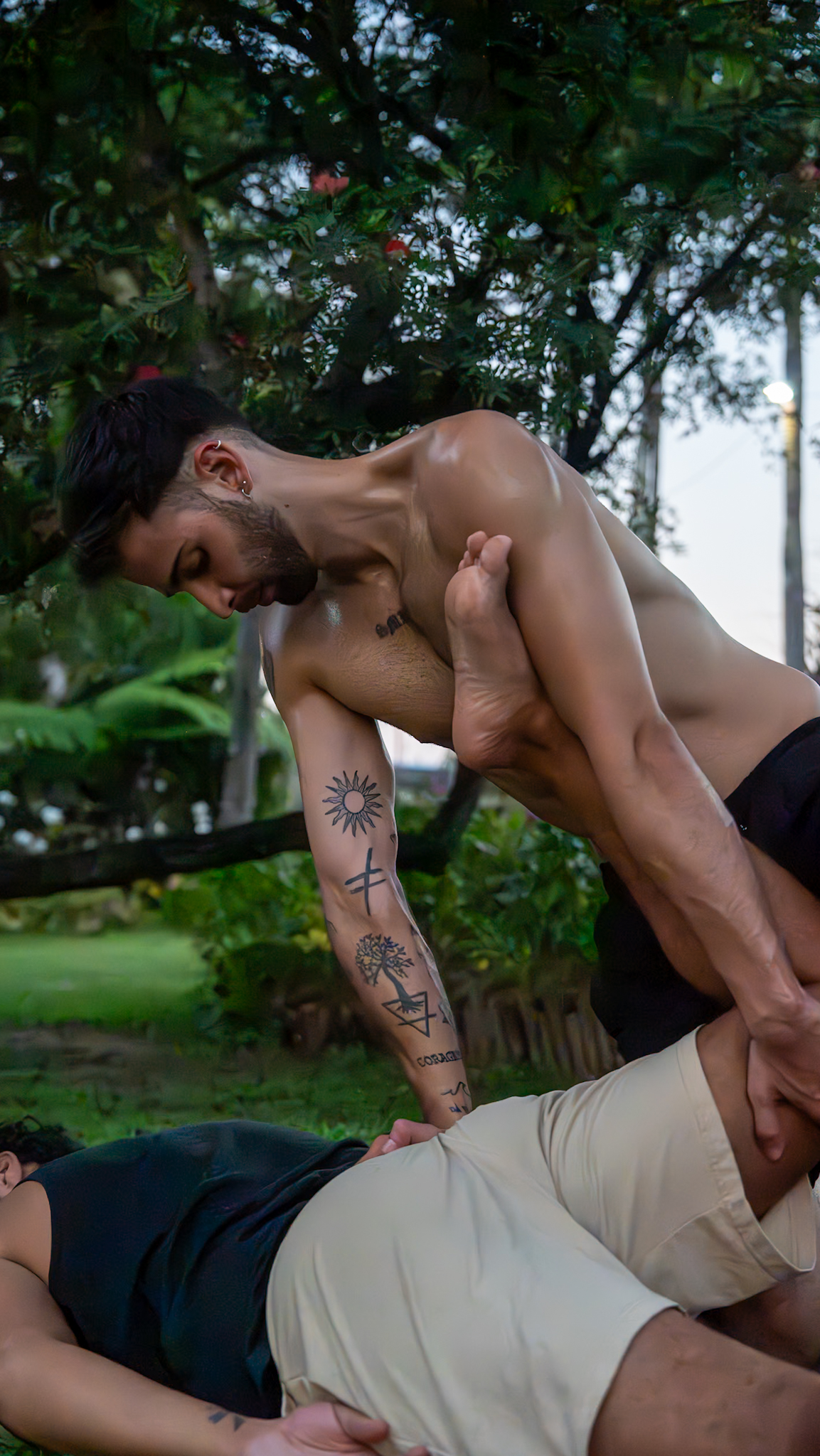
Seven out of ten people who walk into my studio say the same thing, with small variations:
“I have lower back pain that keeps coming back. I’ve done physical therapy. I’ve taken medication. It improves a little, then it returns.”
This is by far one of the most common reasons people come to me. And no wonder. Lower back pain is, according to the World Health Organization, the leading cause of disability in the world today.
This piece is about why that happens, and why traditional Thai Massage can touch that pain in a way other approaches often can’t.
Why the lower back accumulates so much
The lower back is a transition zone. It connects the upper body (which carries weight, posture, arms) with the lower body (which supports, walks, lifts). Every force that runs through the body passes through there.
Add the modern lifestyle on top of that:
- Hours sitting in front of a screen, shortening the hip flexors
- Short, high breathing patterns (chest), without mobilizing the diaphragm
- Chronic stress, which keeps the hips in “defense mode”
- Lack of varied movement, especially rotation and stretching
The result: tension accumulates in the deep muscles of the hips and lower back, especially in the psoas, the quadratus lumborum, and the glutes. These muscles pull the spine in directions it wasn’t designed to go. Pain shows up as the symptom, but the origin is somewhere else.
Why treating only the painful spot rarely works
The first thing most people do when they have lower back pain is massage or stretch the lower back.
It makes sense intuitively. But it usually doesn’t work.
Lower back pain almost never originates only in the lower back. It’s the result of tension accumulated elsewhere: hips, glutes, hamstrings, diaphragm, even the feet. When those muscles are short or locked, they pull the pelvis, which pulls the spine, which produces the pain.
Local massage might provide a few hours of relief. But if the cause is above or below, the pain comes back.
How Thai Massage works differently
Traditional Thai Massage was developed with an integrated view of the body. It’s not a technique that treats isolated points. It moves along energy lines (sen) that run through the entire body.
For lower back pain, this means the work begins far from the lower back.
In a typical session for someone with lower back pain, I:
- Start at the feet. Yes, feet. The lines that support posture begin there. Releasing tension in the feet changes how the entire leg organizes itself.
- Move up through the legs, working hamstrings and glutes. When these are short, they hold the pelvis in anterior rotation, overloading the lower back.
- Open the hips with passive stretches. This is the heart of the work. Postures similar to yoga’s “pigeon,” but I hold them for you, adjusting depth as the body allows.
- Work the psoas. The psoas connects the lumbar spine to the inner thigh. When chronically tense, it literally pulls the spine forward, creating compression in the lower back. Releasing the psoas is often the key that unlocks everything.
- Only then arrive at the lower back itself. Conscious pressure along the lines parallel to the spine, spinal lengthening, breath work.
- Close with inversions and decompressions. Postures where the hips are higher than the head, letting the spine decompress.
This work takes time. That’s why my sessions are long (minimum 1h30, ideally 2h or more). You can’t do this circuit in 30 minutes. And that’s why express sessions rarely resolve chronic lower back pain.
The session I built exactly for this
Alongside the Traditional Thai Massage, I offer a focused session called Hip Release (1h30, R$ 290). It was developed for exactly the profile I described above: focus on legs, hips, and lower back, with myofascial release and decompression techniques.
On the energetic side, it works the lower chakras (root and sacral), which are exactly the ones that hold the emotional aspects connected to the body’s foundation: survival, safety, stability. Often it’s that chronic emotional weight that keeps the lower back locked.
If your main concern is lower back pain and you want to start focused, that’s the way in. If you want broader work (full body), the Traditional Thai Massage in 2h or 3h covers the lower back region as part of the complete circuit.
What to expect right after the session
Every body responds differently, but some patterns are common:
- Immediate sensation of lightness in the hips and lower back
- Walking differently as you leave (more fluid, less stiff)
- Drowsiness: the nervous system shifts into deep rest mode, and most people sleep exceptionally well the following night
- In some cases, mild soreness the next day, similar to post-workout. That’s normal. It means the tissue was mobilized.
What to expect over the following days
Most people report significant reduction in lower back pain right after the first session. But it’s important to set realistic expectations:
- If the pain is new (weeks or a few months): one to three sessions usually resolve it.
- If the pain is chronic (years): this is months of work, not a single session. The body learned a pattern and will need time to reorganize. I recommend starting with weekly or every-other-week sessions for two months, then spacing out.
- If the pain is structural in origin (confirmed hernia, severe scoliosis): massage helps a lot as support, but should be combined with care from a physical therapist or orthopedic doctor.
I don’t replace a doctor. If you have lower back pain that radiates into the leg, numbness, weakness, or pain that appeared suddenly without clear cause, get medical evaluation first. Massage comes after, as part of the treatment.
Who benefits most
Patterns that tend to respond well:
- Lower back pain of postural origin (too much sitting, poor posture)
- Lower back pain related to stress and anxiety (body in constant tension)
- Lower back pain in people who train but don’t recover (lifting, running)
- Postpartum lower back pain (after the recovery period)
- Chronic lower back pain without a clear diagnosis
- Travel/nomad lower back pain (long flights, sleeping in different beds, carrying a backpack daily)
The deeper work
I’ll be honest: often, when the lower back starts to really release, it comes with an emotional release.
I’ve had clients cry in a session without knowing why. Others feel anger. Others go into deep silence for ten minutes at the end, like something had been depressurized.
That’s normal. The body stores stories in tension. When the tension leaves, the story sometimes asks to pass through.
It doesn’t have to happen. But if it does, welcome it. It’s part of the work.
Have chronic lower back pain and want to try? Book the Hip Release session (1h30, R$ 290), or the Traditional Thai Massage 2h if you prefer full-body work. We talk first to understand your story, and we work together. Sessions in Itacaré, Bahia, Brazil. English-speaking, international clients welcome.